¹⁴C-Urea Breath Test Analyzer: Golden standard for Gastric Helicobacter pylori Detection
H. pylori infection is a major contributing factor to chronic gastritis, peptic ulcer disease, and even gastric cancer, and has been classified by the World Health Organization as a Group I carcinogen for human gastric cancer. Early detection and eradication of H. pylori are of great significance in reducing the risk of gastrointestinal diseases. The ¹⁴C-urea breath test (¹⁴C-UBT), featuring its non-invasive nature, high accuracy, and rapid procedure, is recommended by both domestic and international clinical guidelines as the preferred method for diagnosing active H. pylori infection and for post-eradication follow-up.
Principle of Detection: A Simple Breath Sample, Powered by Science
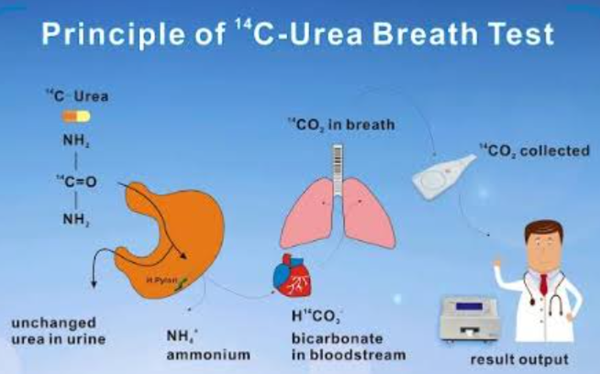
The principle of the ¹⁴C-urea breath test is grounded in the unique biological characteristics of H. pylori. This bacterium produces highly active urease, an enzyme that hydrolyzes urea into ammonia (NH₃) and carbon dioxide (CO₂). After the patient orally administers a capsule containing ¹⁴C-labeled urea, if H. pylori is present in the stomach, the labeled urea is hydrolyzed to produce ¹⁴CO₂. This ¹⁴CO₂ is absorbed through the gastrointestinal tract, enters the bloodstream, and is subsequently exhaled through the lungs. By collecting the patient’s breath sample and using a dedicated analyzer to measure the ¹⁴C decay count rate (CPM or DPM), the presence of active H. pylori in the stomach can be accurately determined.
This diagnostic method achieves an accuracy rate of over 95% and is unaffected by the patchy distribution of H. pylori within the stomach, offering high clinical reliability.
Dual-Channel Design: Enhancing Testing Efficiency and Improving Patient Experience
To meet the high-throughput demands of clinical testing, our company’s ¹⁴C-urea breath test analyzer features a dual-channel parallel detection design. The device enables simultaneous or separate measurement and analysis of breath samples from two independent patients, effectively improving testing efficiency and reducing patient waiting time. This makes it particularly suitable for healthcare institutions with large daily testing volumes. When used in conjunction with the matching ¹⁴C-urea breath test kit, the device offers straightforward operation and reliable, objective results.
Target Populations and Clinical Value
This product is intended for patients with gastrointestinal symptoms who require confirmation of current H. pylori infection status, particularly for preliminary screening of high-risk populations, including those with peptic ulcer disease, chronic gastritis, gastric mucosa-associated lymphoid tissue (MALT) lymphoma, and a family history of gastric cancer. It is also widely used for therapeutic efficacy assessment following H. pylori eradication therapy, helping to confirm whether successful eradication has been achieved. Retesting is recommended to be performed at least 4 weeks after the completion of anti-H. pylori treatment.
Precautions for Testing
To ensure the accuracy of test results, the following precautions should be observed prior to testing:
- Fasting Requirement: Fasting (at least 2 hours of no food intake) is recommended before testing to prevent food from interfering with the contact between the reagent and the gastric wall.
- Medication Withdrawal: Antibiotics and bismuth-containing preparations should be discontinued for at least 4 weeks prior to testing; proton pump inhibitors (PPIs) and H₂-receptor antagonists should be withdrawn for at least 2 weeks prior.
- Population Considerations: Safety has not been fully established for pregnant women, lactating women, and children; use in these populations should be carefully considered.
The ¹⁴C-Urea Breath Test Analyzer serves as a reliable tool for clinical detection of H. pylori infection. Grounded in scientific principles and dedicated to precise detection, it supports the early identification and standardized management of gastrointestinal diseases.
Post time: Aug-07-2026