Catching the “Silent Early Stage” of Diabetes: From Symptom Awareness to Precision Testing
Early diabetes often does not present with the classic “three increases and one decrease” (polydipsia, polyphagia, polyuria, and weight loss). Fatigue, recurrent infections, slower wound healing, and unexplained postprandial hunger or palpitations are often attributed to stress or aging. What truly drives disease progression is the slow erosion of blood vessels and nerves caused by long-term hyperglycemia. Postprandial hyperglycemia is precisely the main manifestation of early glucose metabolism abnormalities: among newly diagnosed diabetes patients, isolated postprandial hyperglycemia accounts for 49%, while isolated fasting hyperglycemia accounts for only 12%. This means that if screening relies only on fasting glucose, a substantial proportion of early patients will slip through.
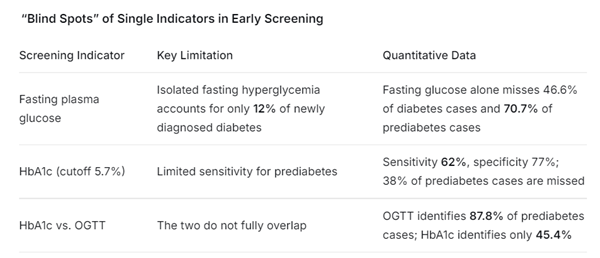
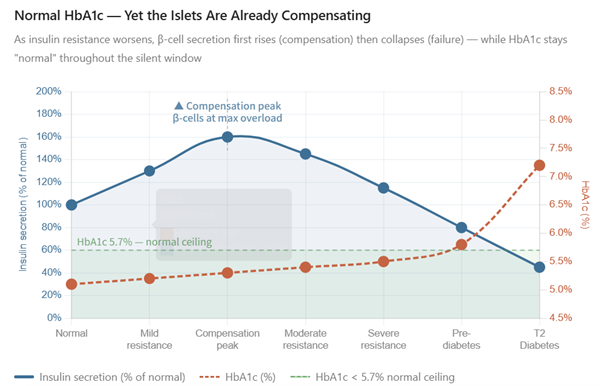
To catch the early stage, two dimensions must be assessed simultaneously: the “result” of glycemic exposure and the “compensatory state” of islet function. HbA1c reflects the average blood glucose level over the past 2–3 months and is not affected by transient fluctuations at a single blood draw. It is one of the “gold standards” for early screening and long-term management. However, HbA1c cannot answer a key question: Are the islets still making an effort, and in what way?
The pathophysiological trajectory of early type 2 diabetes is relatively clear: at the impaired glucose tolerance stage, insulin sensitivity has already shown a “dramatic fall,” while fasting and postprandial insulin responses are compensatorily elevated, although the early insulin secretion response is already significantly impaired. As the disease progresses toward diabetes, the driving force of hyperglycemia gradually shifts from insulin resistance to the progressive decline of β-cell secretory function. In other words, when HbA1c is still “barely normal,” INS and C-P may already be sounding the alarm. C-peptide and insulin are secreted in a 1:1 ratio, and C-peptide is more metabolically stable, so it can more reliably reflect endogenous insulin secretion capacity. Combined INS/C-P testing can identify people with hyperinsulinemia, delayed secretion peaks, or β-cell compensatory limits while glucose is still borderline.
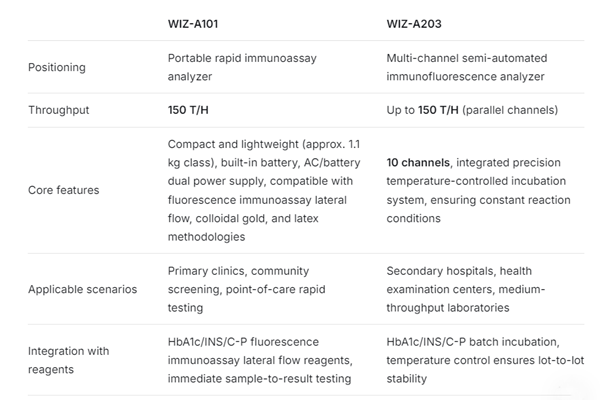
To meet this need, we provide HbA1c, INS, and C-P fluorescence immunoassay reagent combinations, together with two reader instruments adapted to different scenarios:
It is worth emphasizing that HbA1c is not meant to be “replaced”; rather, it needs to be placed within a more complete interpretive framework. When HbA1c is in the gray zone, or when fasting glucose is normal but metabolic risk is present, INS and C-P provide information that HbA1c cannot: whether β-cells are overcompensating, have a delayed peak, or have already entered a trajectory of declining secretory function. This judgment directly affects the urgency of intervention and the choice of approach.
The early window of diabetes is often opened before symptoms are “explained away.” Using HbA1c to see average blood glucose and using INS/C-P to see what is happening in the islets is a reliable path to truly moving the prevention and control gateway forward.
Post time: Oct-22-2026