HBsAg Testing: From Screening to Precision Management
The narrative of hepatitis B prevention and control is undergoing a key shift. As new infections continue to decline due to widespread vaccination, the real challenge has moved to the existing infected population. WHO estimates that approximately 240 million people worldwide were living with chronic HBV in 2024, with 102 million in the Western Pacific Region alone—a region that carries about 42% of the global disease burden. China’s numbers are even more concentrated: approximately 75 million people are living with HBV, but the diagnosis rate is only 22% and the treatment rate is as low as 15%. Of the roughly 17 million people who require antiviral treatment, only about 3 million actually receive standardized treatment, and another 30 million are unaware that they are infected. This means that among every five people who need treatment, more than four have not yet entered the care pathway.
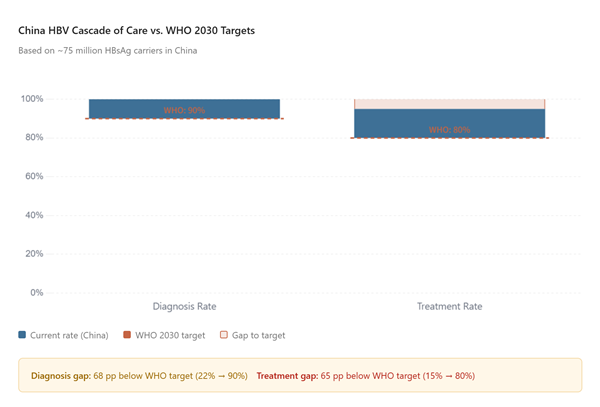
The gap first appears at the “finding” stage, but how “management” is carried out after detection is the real dividing line that determines long-term outcomes. As the anchor indicator for the diagnosis of chronic HBV infection, HBsAg has expanded from a single qualitative judgment into a continuous variable that runs through screening, stratification, treatment decisions, and efficacy monitoring. The 2025 EASL guidelines explicitly define functional cure as sustained HBsAg clearance and include qHBsAg in routine disease staging assessment. The AASLD/IDSA 2025 guidelines further identify HBsAg ≤ 100 IU/mL as a key threshold for considering treatment discontinuation in selected patients. APASL 2026 proposes that patients with sustained virological suppression and HBsAg < 1,500 IU/mL may consider combination therapy with Peg-IFN-α to pursue functional cure. From 1,500 to 100 IU/mL, these thresholds form a decision chain that requires a testing system capable of quantification, comparability, and reliable performance in the low-concentration range. A qualitative test strip cannot answer the question “How much did HBsAg drop from 800?”—yet this is precisely the basis for treatment adjustment and discontinuation decisions.
The two HBsAg product lines developed by Xiamen Baysen Medical are essentially a response to this tiered demand: colloidal gold rapid testing addresses the question of “reachability,” extending screening to primary care and resource-limited settings; fluorescence immunochromatography quantitative testing addresses the question of “manageability,” providing quantifiable dynamic information for treatment decisions and follow-up.
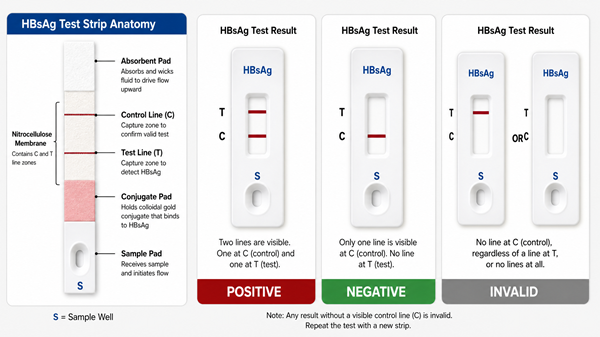
The core value of colloidal gold rapid testing lies in accessibility. Domestic HBsAg colloidal gold test strips have reached a sensitivity of approximately 1 ng/mL, with specificity of up to 100% and a concordance rate of about 99% with enzyme immunoassays. They require no instrument, support single-sample operation, and provide results in a short time, making them the most practical tool for closing the diagnostic gap of “30 million people with unknown infection status.” The reagent can be read visually as a standalone test or read on the WIZ-A101 or WIZ-A203, converting the color band signal into standardized data and making primary-care screening results recordable and traceable.
Fluorescence quantitative testing responds to the need for “management precision.” It uses fluorescent labels instead of colloidal gold as the signal reporter and eliminates the subjectivity of visual interpretation through photoelectric reading by the instrument. Studies have shown that a rare-earth fluorescent immunochromatography method for HBsAg detection can achieve a linear range of 0.2–500 ng/mL, a limit of detection of 0.16 ng/mL, intra-assay CV < 5%, inter-assay CV < 8%, and R² of 0.9996, demonstrating the ability to provide stable quantitative results in the low-concentration range. This performance level means that dynamic monitoring of HBsAg no longer necessarily depends on large chemiluminescence platforms and can be completed in POCT settings.
The two instruments complement each other in terms of application scenarios. WIZ-A101 is positioned as a portable quantitative node: dimensions of 194×98×117 mm, weight of 1.1 kg, built-in battery, compatibility with fluorescence immunochromatography, colloidal gold, and latex methods, throughput of 150 tests/hour, and LIS connectivity. It is suitable for specialty clinics, bedside follow-up, and primary-care testing points, enabling “HBsAg trend tracking during treatment” to be completed immediately at the point of patient visit. WIZ-A203 is positioned as a channel-based workflow platform: a 10-channel semi-automated design integrating colloidal gold and fluorescence dual methodologies, with a built-in temperature control module and a maximum throughput of 70 tests/hour. It is suitable for small and medium-sized laboratories that need to switch flexibly between screening and quantitative monitoring, using a single instrument to cover rapid screening for infectious diseases and HBsAg quantitative confirmation.
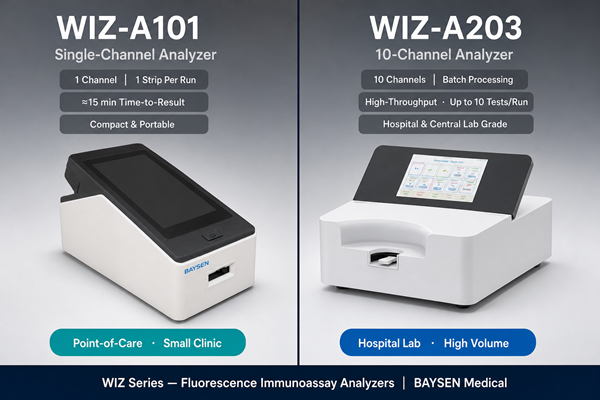
Placing the two product lines side by side reveals a complete product logic: colloidal gold solves “can it be detected” with the lowest threshold, fluorescence quantification solves “can it be managed” with quantifiable performance, and WIZ-A101 and WIZ-A203 embed these two capabilities into different nodes from primary-care screening to specialty management. Under the WHO framework of “90% diagnosis and 80% treatment by 2030,” accessibility and precision are not an either-or choice; they are two dimensions that must be addressed simultaneously through productization.
Post time: Oct-28-2026