SAA: The “Sensitive Sentinel” for Infection and Inflammation Monitoring
In the field of clinical lab testing, when we need to judge the presence of infection or inflammation in the body, the most familiar indicators are undoubtedly the white blood cell count in the complete blood count and C-reactive protein (CRP). However, within the “family” of inflammatory markers, there is another equally important yet often overlooked member—Serum Amyloid A Protein (SAA). As a professional manufacturer of in vitro diagnostic reagents, we invite you to delve deeper into understanding this “sensitive sentinel” for infection and inflammation monitoring.
What is SAA?
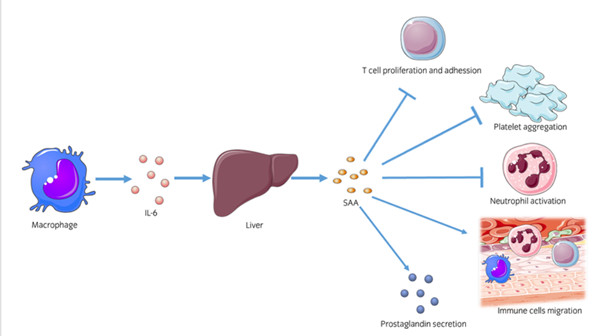
As an acute phase protein, serum amyloid A belongs to heterogeneous proteins of apolipoprotein family, whichhas relative molecular weight of approx. 12000. Many cytokines are involved in the regulation of SAA expressionin acute phase response. Stimulated by interleukin-1 (IL-1), interleukin-6 (IL-6) and tumor necrosis factor-a(TNF-a), SAA is synthesized by activated macrophages and fibroblast in liver, which has short half-life of onlyaround 50 minutes. SAA bonds with high-density lipoprotein (HDL) in blood rapidly upon synthesis in liver, whichneeds to be degraded by serum, cell surface and intracellular proteases. In case of certain acute and chronicinflammation or infection, degradation rate of SAA in body obviously slows down while synthesis increases,which lead to continuous rise in SAA concentration in blood. SAA is an acute phase protein and inflammatorymarker synthesized by hepatocytes. SAA concentration in blood will increase within a couple of hours uponoccurrence of inflammation, and SAA concentration will experience 1000-times increase during acuteinflammation. Therefore, SAA can be used as an indicator of microbial infection or various inflammations, whichcan facilitate diagnosis of inflammation and monitoring of therapeutic activities.
The Unique Clinical Value of SAA
In clinical applications,SAA is often combined with complete blood count and CRP to form an “inflammatory triple test,” providing doctors with more comprehensive diagnostic information.Its unique value is mainly reflected in the following three aspects:
1)A Expert at differentiating between viral and bacterial infections
This is the most prominent advantage of SAA. In bacterial infections, both SAA and CRP are typically significantly elevated. However, during the acute phase of viral infections (such as influenza, hand, foot, and mouth disease, etc.), SAA levels often increase markedly, while CRP usually remains normal or only mildly elevated. This characteristic allows SAA to effectively compensate for the shortcomings of CRP in diagnosing viral infections, helping physicians quickly and preliminarily distinguish between infection types, thereby providing an important reference for the rational use of antibiotics.
2) A “Hypersensitive” Indicator for Inflammation Monitoring
SAA possesses extremely high sensitivity. In the very early stages of infection or inflammation, when CRP levels have not yet shown significant changes, SAA may already be on the rise. Conversely, when the condition is controlled or during recovery, SAA can rapidly decline to normal levels. Therefore, dynamically monitoring changes in SAA aids clinicians in assessing treatment efficacy and determining disease prognosis.
3)Auxiliary Diagnosis in Neonatal Infections
The immune systems of newborns, especially premature infants, are not fully developed, making the clinical presentation of infections atypical. As a sensitive inflammatory marker, SAA can assist in the earlier detection of potential infections clinically, buying valuable time for timely intervention.
Our Products and Services
As a company deeply rooted in the in vitro diagnostics field, we Baysen Medical understand the crucial importance of accurate and timely test results for clinical decision-making. Our SAA FIA Reagent with WIZ-A101 and WIZ-A203 utilizes advanced immunoturbidimetry, featuring high sensitivity, strong specificity, and a wide linear range. This product is compatible with various fully automated biochemical analyzers, is easy to operate, and provides stable results. It accurately quantifies SAA levels in serum or plasma, providing reliable technical support for clinical differential diagnosis, disease monitoring, and medication guidance.
Post time: Feb-24-2026