One Tube of Blood for Gastric Health – The Gastric Function Three-Item Test: A “Scout” for Early Gastric Cancer Screening

Stomach pain, bloating, acid reflux, heartburn… have you become accustomed to these chronic stomach ailments? Many people find that stomach discomfort is simply a matter of enduring it or taking some stomach medication. However, you may not know that early-stage stomach cancer often presents with almost no typical symptoms, and by the time noticeable discomfort appears, the optimal treatment window has often passed.
my country has a high incidence of stomach cancer, accounting for nearly half of the global total in both new cases and deaths each year. Even more heartbreaking is that most patients are diagnosed at an advanced stage, with a 5-year survival rate of less than 30%. In contrast, the 5-year survival rate for early-stage stomach cancer can exceed 90%.
Early detection is the best treatment.
When it comes to stomach examinations, most people first think of gastroscopy. Gastroscopy is the gold standard, but the procedure is painful, requires intubation, and deters many people. Is there a non-invasive, convenient, and repeatable method to perform a preliminary screening of stomach health?
The answer is the serological gastric function three‑item test.
What are the three gastric function markers?
With a simple blood draw, three key indicators are measured:
1)Pepsinogen I (PG I) – reflects the function of acid‑secreting cells in the gastric fundus and body.
2)Pepsinogen II (PG II) – reflects the condition of the gastric mucosa throughout the stomach (including the antrum).
3)Gastrin‑17 (G‑17) – reflects the health of the gastric antrum and the regulation of gastric acid secretion.
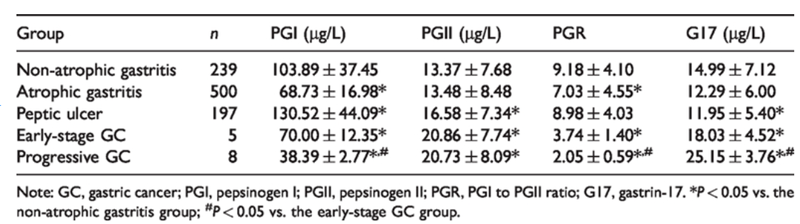
By analyzing the levels and ratios of these three indicators (especially the PG I/PG II ratio), doctors can act like “scouts” to assess whether the gastric mucosa has precancerous changes such as atrophy, intestinal metaplasia, or inflammation, and then decide whether further endoscopic confirmation is needed.
Why choose the immunofluorescence platform?
Our immunofluorescence technology platform makes the gastric function three‑item test faster, more sensitive, and more reliable:
1)Only a small amount of venous blood is required, with results in 15‑20 minutes.
2)High sensitivity to accurately capture early, subtle changes in the gastric mucosa.
3)Minimal interference from common medications, giving stable results suitable for large‑scale screening and dynamic monitoring.
Who should take the gastric function three‑item test?
If you belong to any of the following groups, it is recommended to get tested:
1)Age 40 or older, regardless of symptoms
2)Long‑term Helicobacter pylori (Hp) infection
3)Family history of gastric cancer
4)Long‑term high‑salt, pickled diet, smoking or heavy alcohol use
5)Recurrent upper abdominal discomfort, stomach pain, bloating, acid reflux
6)History of chronic atrophic gastritis, gastric ulcer, gastric polyps, or other gastric diseases
One blood draw – a “health barometer” for your stomach
The gastric function three‑item test is non‑invasive, safe, and economical, serving as a precise triage tool before endoscopy. Those at high risk can promptly undergo endoscopy, while those at low risk can have regular serum marker follow‑ups, avoiding unnecessary invasive procedures.
We Baysen Medical is always focus on diagnostic technique to improve the quality of life . We have developed 5 technology platforms- Latex , colloidal gold , Fluorescence Immunochromatographic Assay , Molecular,Chemiluminescence Immunoassay, Our G17/PGI/PGII Combo FIA Reagent with Immunoassay analyzer WIZ-A203,WIZ-101 Reader are easy operation and can get test result in 15 mins
Post time: Apr-13-2026